You hit 100 Google reviews. That's worth something — most clinics never get there.
Whether it's enough to actually rank you depends on one thing: who you're competing against.
In a smaller town, where the clinics around you sit at 30 or 40 reviews, 100 puts you clearly ahead. In Delhi, Mumbai, Bengaluru, Hyderabad or Pune — where the clinics at the top carry 1,000 to 2,000+ — 100 will not move you much.
There is no magic number. There is only your number against theirs.
Does Google need 100 reviews to rank you?
No. Google has never published a number, because there isn’t one.
Reviews are one way Google measures whether people trust you. They are not the only way. Your location, how complete your profile is, how recent the reviews are, how active you are, how relevant you are to what someone actually typed — all of it counts.
Which is why a clinic with 80 reviews can sit above one with 300.
So the useful question isn't “is 100 enough”. It's: how many do the clinics ranking above me have?
That one question tells you more than any benchmark I could give you.
When 100 is genuinely enough
If you run a dental clinic in a smaller city and the practices around you are under 50 reviews, 100 is a real advantage. Patients notice it, and so does Google.
Same if you're new and got to 100 quickly on honest feedback. Against neighbours with a handful of reviews, you're already ahead.
The point was never the 100. It's that 100 is more than what's around you.
When it isn't
In a competitive city, 100 doesn't go far.
Search “dermatologist in Bengaluru” or “cosmetic clinic in Mumbai” and look at who sits at the top. Hundreds, often thousands of reviews. Most of them have been at it for years, and they are still collecting every week.
That doesn't mean you can't compete. It means 100 isn't the finish line you thought it was.
100 reviews in a small city vs a metro
| Scenario | Small City or Low-Competition Area | Tier 1 City or High-Competition Area |
|---|---|---|
| Average reviews of competing clinics | 30 to 80 | 500 to 2,000+ |
| Can 100 reviews help you stand out? | Yes, in many cases | Usually not on their own |
| Competition level | Lower | Much higher |
| What should your goal be? | Continue collecting reviews consistently | Match and gradually outperform local competitors |
Same number, completely different outcome. It comes down to where you are and who is standing next to you.
Don't guess. Go and look.
Open Google Maps and search your specialty and your city — “dentist in Jaipur”, “orthopedic clinic in Hyderabad”.
Look at the three clinics at the top, and ask:
- How many reviews do they have?
- What's their average rating?
- Are they still getting new ones every week?
- How does your profile compare?
Ten minutes of that beats any number I could quote you. For one clinic the honest answer is 100. For another it is 500, or 1,000.
Why some clinics rank higher with fewer reviews
Because it was never just a count.
Two clinics, same city. One has 600 reviews, most of them years old. The other has 250, gets fresh ones every week, replies to them, keeps its profile current.
The second one often wins. Recency and activity carry real weight, and a pile of old reviews goes stale.
What the clinics at the top have in common
They never stopped asking.
Whether they're at 200 or 2,000, they are still requesting feedback from happy patients. That's the difference. It's not clever.
They also keep the profile updated, reply to reviews, add photos. But underneath all of it is consistency — review collection was never a campaign they ran once. It is part of the week.
So how do you keep them coming?
Most patients aren't unwilling. They just never get asked.
The best moment is right after a good consultation or treatment, while it is still fresh. A request at reception, a WhatsApp message afterwards, a direct review link — any of it works.
The goal isn't a big month. It's a steady one. A few genuine reviews every week compounds into something your competitors can't catch quickly.
The part that actually breaks
This is where it falls apart for most clinics, and the reason is boring: the ask depends on someone remembering.
On a busy day, with patients waiting and the phone going, asking for a review is the first thing that gets dropped. Nobody decided to skip it. It just never happened.
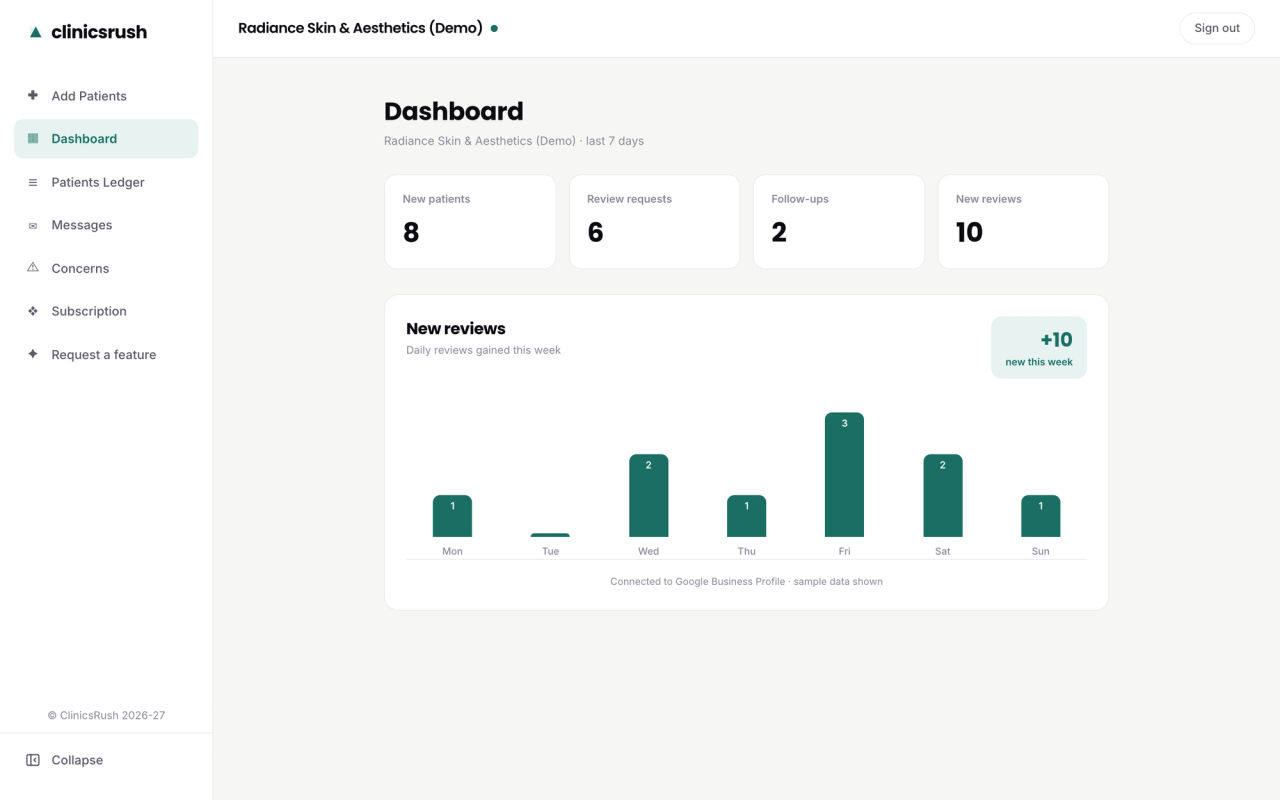
That one job is what ClinicsRush does. Your team adds the patient in about ten seconds after the visit. The patient gets a warm WhatsApp message at the right moment. Happy patients go straight to your Google review page, and unhappy ones reach you privately first, before it becomes a public review.
Nobody has to remember anything.
So, are 100 reviews good?
Sometimes, yes.
Small town, limited competition — 100 may be all you need.
Busy city, where the clinics above you already have hundreds or thousands — you will need to aim higher, and keep going.
Either way, stop measuring yourself against a round number. Measure against the clinics ranking above you. That is the only benchmark that means anything.
Google isn't rewarding you for hitting 100. It's rewarding clinics that keep earning trust from real patients, week after week. That's the whole game.