There is no fixed number. But there is a number for your clinic, in your city, for your treatment — and you can work it out.
A clinic with 500 reviews can sit below a clinic with 150, if the second one is collecting reviews every month, replying to them, and keeping an active Google Business Profile.
Google counts reviews. It also reads freshness, frequency, what the reviews say, how active your profile is, and who else is competing for the same patients.
So the question is not "how many reviews do I need?" It is "how many do I need compared to the clinics already ranking above me?"
Why There Is No Magic Review Number
Crossing 100, 500 or 1,000 reviews does not buy you a ranking.
Two dermatology clinics in the same city:
| Clinic | Total Reviews | New Reviews Last 90 Days |
|---|---|---|
| Clinic A | 900 | 2 |
| Clinic B | 450 | 35 |
Clinic A has twice the reviews. Clinic B can still outrank it, because Google sees patients still showing up and still talking.
That is review velocity, and it now carries more weight than the total.
Your Competitors Set the Number
Google does not rank your clinic in isolation. It ranks you against the clinics fighting for the same patients.
If the top clinics in your area have 1,500 reviews, 200 will not get you there.
If they have a few hundred, you do not need thousands.
Open Google Maps, search your main treatment plus your city, and write down the review counts of the top three results. That is your target. Nobody else can give you that number.
What Top-Ranking Clinics In Major Indian Cities Actually Have (Our Research)
We wanted a real benchmark instead of generic SEO advice, so we looked at the top three Google-ranked clinics across several major Indian cities.
Hair Transplant Clinics
| City | Average Reviews of Top 3 Clinics |
|---|---|
| Bangalore | 1,097 |
| Mumbai | 852 |
| Delhi | 1,291 |
| Ahmedabad | 821 |
| Pune | 1,436 |
| Chennai | 786 |
| Hyderabad | 1,167 |
Average across these cities: around 1,064 reviews.
Pune's top clinics averaged well over 1,400. Other cities ranked leaders with far fewer.
If review count alone decided rankings, those numbers would be far more consistent than they are.
PRP Clinics
Same pattern with PRP.
| City | Average Reviews of Top 3 Clinics |
|---|---|
| Bangalore | 1,495 |
| Delhi | 784 |
| Mumbai | 342 |
| Ahmedabad | 881 |
| Pune | 1,359 |
| Hyderabad | 1,160 |
| Chennai | 1,400 |
Average across these cities: around 1,060 reviews.
Mumbai had clinics in the top results on a few hundred reviews. Bangalore's top three averaged nearly 1,500.
Same treatment, same country, four times the requirement. The number is set by your street, not by an industry average.
What If Your Area Has Limited Patient Demand?
Most SEO articles skip this. If only a small number of people in your area need a specific treatment, your review growth will be slower. That is arithmetic, not a failure.
A niche specialist in a low-population locality cannot produce the review volume of a large multi-specialty clinic in a metro.
In that case, stop chasing a big number and start converting the patients you already see. Every satisfied patient is worth more to you than to the clinic down the road in Delhi.
The Metric That Matters More Than Total Reviews
Review Velocity
The clearest pattern across high-performing clinic profiles is that reviews keep arriving.
A clinic collecting reviews all year usually beats one that got a big burst and then went quiet.
So do not aim for 500 reviews. Aim for a steady number every month. Consistency reads as a stronger signal than a spike.
Why Review Replies Matter
Plenty of clinics collect reviews and never reply to a single one.
Replying shows patients, and Google, that someone is actually managing the profile. Short and professional is enough.
The strongest clinic profiles usually combine:
- Consistent review growth
- Fast review responses
- Updated business information
- Regular photo uploads
- Ongoing profile activity
How to Increase Review Volume Without Breaking Google's Guidelines
What actually works:
- Asking patients after a positive treatment experience
- Sharing direct review links through WhatsApp or SMS
- Using QR codes at reception desks
- Following up a few days after treatment
- Responding quickly to every review received
The goal is not to pressure anyone. It is to remove the friction between a happy patient and the review box.
The Clinics Winning More Reviews Have a Better Process
The problem is rarely treatment quality, and rarely patient satisfaction.
A patient leaves happy, gets back to work and family, and the moment passes. Timing does most of the work here — patients write reviews shortly after a good experience, not three weeks later.
That makes review collection a process, not a request your front desk has to remember.
How ClinicsRush Fits Into This
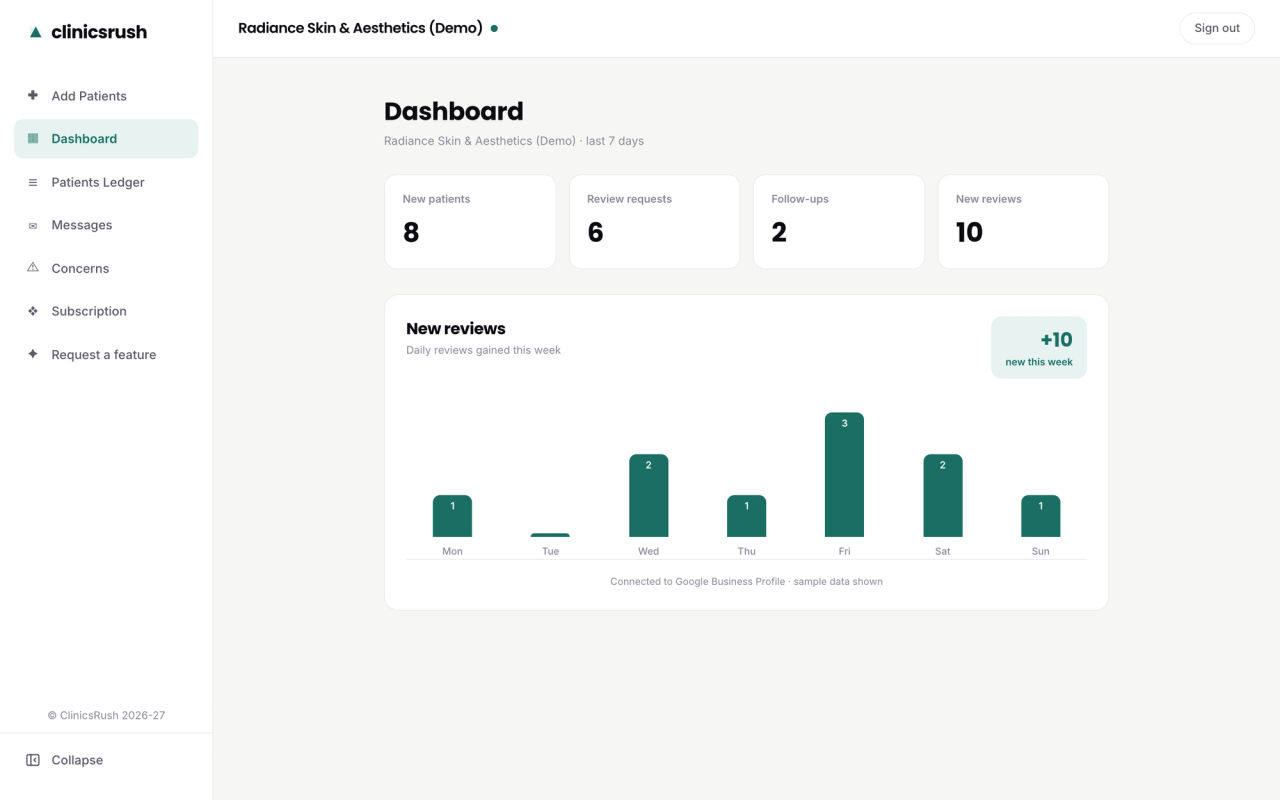
Your team adds a patient in about ten seconds after the visit. That is the whole job.
The patient then gets a warm WhatsApp message at the right moment. Happy patients go straight to your Google review page. Unhappy ones reach you privately first, before it becomes a public review.
Nobody has to remember anything, and reviews stop depending on how busy the day was.
If you want the larger version of this, we also build the Booked Out Clinic System: a paid-consultation funnel that brings in higher-value patients, the follow-up automation that makes them show up and come back, and the local SEO around it. Built once, and it is yours to keep.
Reviews Alone Won't Rank Your Clinic
Reviews are powerful. Rankings still depend on:
- Google Business Profile optimization
- Service pages
- Website quality
- Local relevance
- Citations
- Location proximity
- Competition level
Reviews amplify all of that. They do not replace it.
So, How Many Reviews Does Your Clinic Need?
For some clinics, a few hundred. For others, several thousand. Go and check your top three competitors, and you will know which one you are.
Then beat their monthly pace rather than their total.
The clinics that rank well are rarely the ones chasing a number. They are the ones collecting reviews every month, replying quickly, keeping the profile alive, and making it easy for a satisfied patient to say so.