You claimed your Google Business Profile. The timings are updated, the address is right, the phone number works, the photos are professional. Your Facebook and Instagram are active.
And a clinic down the road still shows up above you every single time.
I get asked about this a lot. From the outside everything looks done, so the gap makes no sense.
There is rarely one reason. That is the annoying part.
Google is trying to answer one question: which clinic near this person is most likely to give them a good experience. It reads dozens of signals to guess at that. Some are obvious. Most clinics never touch the rest.
Here is where I would look first.
Is Your Clinic Information the Same Everywhere?
Before Google recommends you, it has to trust that all these listings are actually you.
The clinic name on Google should match Facebook, Instagram, YouTube, healthcare directories and your website. Same phone number everywhere. Same address, timings, website URL, services.
If your Google profile shows one number and a directory shows another, Google is now reading two businesses instead of one. Same thing when the clinic name is written three different ways, or when you update one platform and forget the other five.
Fix this and you have earned the right to compete. You have not won anything yet.
Which is where most clinic owners get stuck. They clean all of it up and still do not rank.
A Complete Profile Is Not a Ranking Strategy
Plenty of clinics have already done everything the guides tell them to do. Their profile has:
- Updated contact information
- Professional clinic photographs
- Service listings
- Business descriptions
- Operating hours
- Website links
Some post regular updates and manage their social media properly. They still cannot get visible.
If profile optimisation were the whole game, these clinics would own local search. They don't.
When I compare the clinics that sit at the top against the ones that don't, one gap shows up more than any other. Reviews.
The Review Gap
Look at the clinics holding the top local results in any major city. Many of them have hundreds or thousands of reviews. Some are at 800. Some have crossed 2,000 or 3,000.
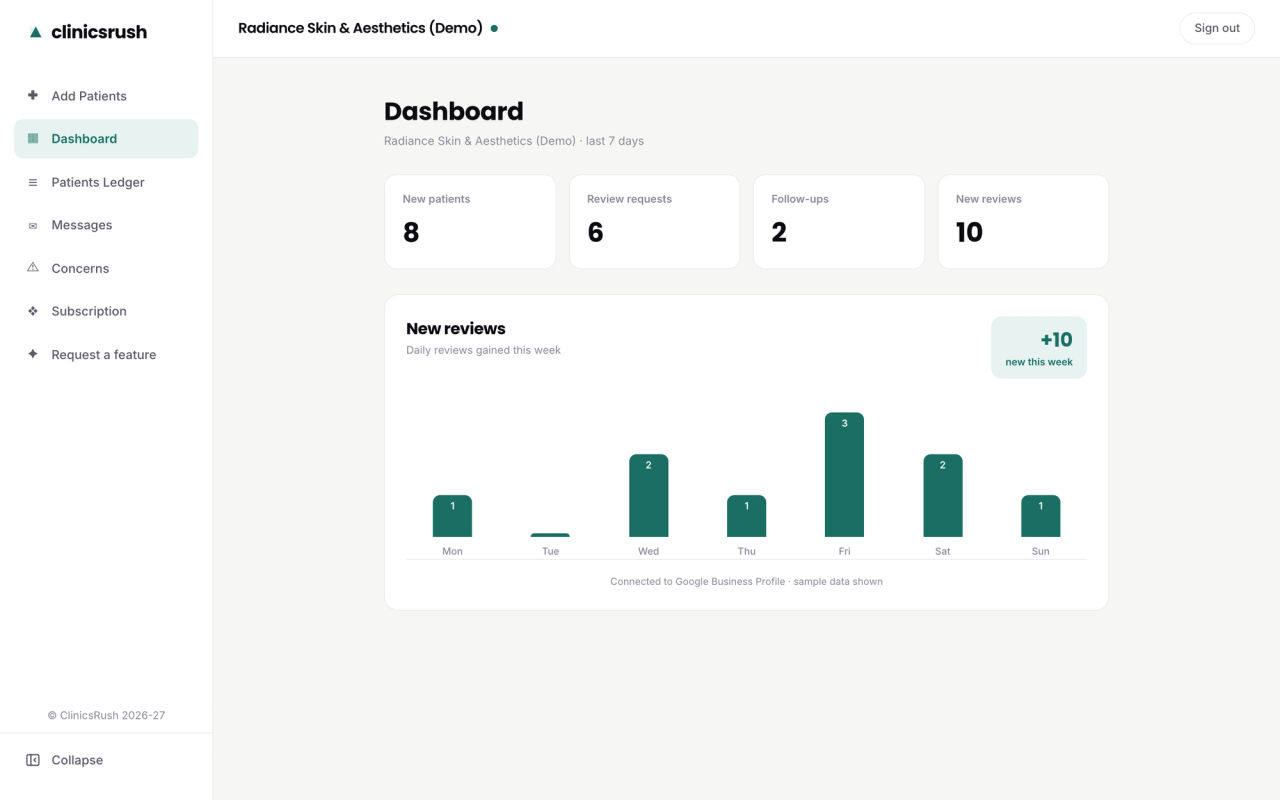
More importantly, the reviews are not sitting there from three years ago. New ones keep landing every week.
Now the clinics that struggle. Some have 15 reviews. Some have 40, or 60, or 100. In a lot of cases the last one was posted months ago.
To Google those are two very different businesses. One looks busy and trusted. The other looks quiet.
This does not mean 200 reviews can never beat 2,000. Rankings move on several factors. But when two clinics offer similar treatments in the same area, review signals are usually what separates them.
Fresh Reviews Beat a Big Old Number
Most clinic owners watch the total count. The pattern matters just as much.
Clinic A has 300 reviews and has not received a new one in three months.
Clinic B has 180 reviews and gets two or three every week.
Clinic B looks like a clinic that is still seeing happy patients today. Google reads it the same way.
That is why some clinics climb steadily while others sit still on a respectable-looking number.
Your Patients Are Not Unwilling. They Are Busy.
The common assumption is that patients do not want to leave reviews.
Most of them are just busy. They leave the clinic, get back to work, and the request is gone from their head by evening.
The problem is almost never satisfaction. The problem is that there is no process.
Most clinics rely on reviews happening on their own — a patient remembering, opening Google, and writing something unprompted. That happens occasionally. It does not happen consistently.
Clinics that get reviews every week make it easy. They ask at the right moment, they follow up, and they treat it as part of the visit instead of something the front desk does when it remembers.
Timing Decides Whether You Get It
Ask at the wrong moment and you get nothing.
Right after a consultation, treatment or follow-up where the patient is clearly happy — that is when a request works. The same message two weeks later gets ignored, because they have moved on.
The fixes here are small. A review QR code at reception. A review link inside the follow-up message. Front desk staff who know to ask a satisfied patient before they walk out.
None of it is clever. Together it produces a steady flow instead of a burst.
Where We Help
This is the part we built ClinicsRush for. Your team adds a patient in about ten seconds after the visit. The patient gets a warm WhatsApp message at the moment they are most likely to respond. Happy patients go straight to your Google review page. Unhappy ones reach you privately first, before it turns into a public review.
Nobody has to remember anything, which is the only version of this that survives a busy OPD day.
If the ranking problem is bigger than reviews, that is the Booked Out Clinic System — a paid-consultation funnel that brings in higher-value patients, the follow-up automation that gets them to show up and come back, and the local SEO around it. Built once, and yours to keep.
Is Your Profile Active, or Just Existing?
Most clinics treat the Google Business Profile as a setup task. Create it, upload photos, fill in the details, never open it again.
Inactive profiles look neglected. Patients notice. Google notices.
This does not mean posting daily or turning your clinic into a content brand. It means recent photographs, service information that is still true, accurate timings, the occasional post, and replies to reviews.
When someone opens your listing it should look like a clinic seeing patients this week.
What Happens After Someone Clicks Through?
Google does not stop at the profile. It reads your website too.
Most clinic websites are too vague. A page says "Dental Services" or "Skin Treatments" and stops there.
Google prefers clarity. The clearer your services, specialities and locations are, the easier it is to match you to a search.
A patient searching for one specific treatment will find the clinic whose website explains that treatment, not the one with a broad category page.
Location matters the same way. Clinics that rank well usually have pages that spell out the areas they serve.
Engagement Is a Ranking Signal Too
Google is not trying to find clinics. It is trying to find clinics people trust.
Reviews are one form of that. So is everything else patients do — clicking your profile, calling, opening your website, requesting directions, reading a page instead of bouncing off it.
Local SEO is not a keyword exercise. It is a profile and a website that actually help someone decide.
So Why Is Your Clinic Not Ranking?
Usually it is not a missing keyword or a technical fault. It is several small things at once.
Your information is not fully consistent across platforms. Your profile has not been touched in months. Your website does not say clearly what you treat or where.
And the clinic ahead of you is collecting genuine patient reviews every week while you are not.
Most clinics spend their effort setting up an online presence and almost none maintaining it. The ones sitting at the top treat it as something ongoing.
All of this is fixable. None of it is a shortcut. It is just the trust signals Google has been asking for the whole time.